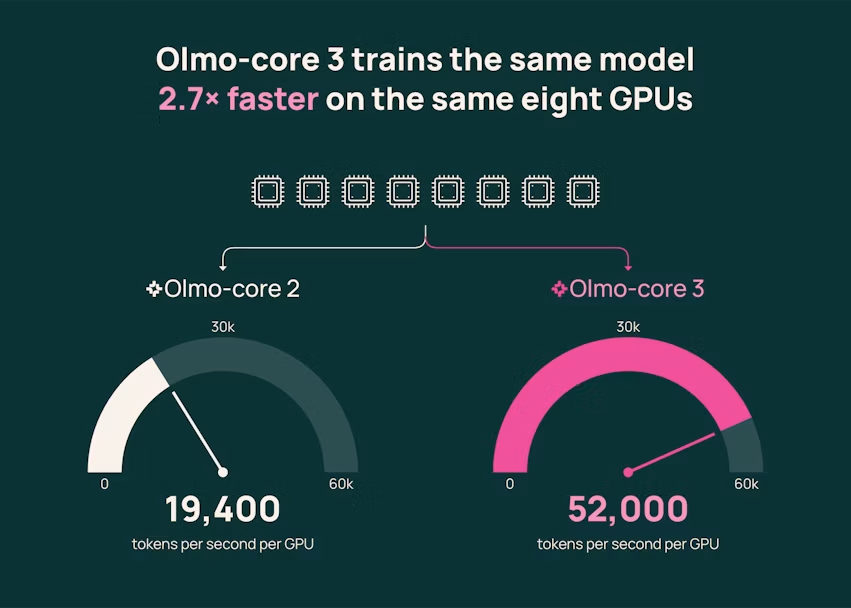
This week, we’re releasing two new open artifacts for researchers and model builders: AstaBrief 8B, a model for generating fast, cited scientific reports, and Olmo-core 3, our redesigned framework for training large mixture-of-experts (MoE) models.
Together, they reflect our approach to truly open AI—sharing models and the infrastructure behind them so others can inspect how they work and adapt them to new problems. From scientific synthesis to large-scale model training, we want to make advanced AI systems more accessible to – and reproducible by – more people.
Heads up: We'll be at COLM 2026 in San Francisco, October 6–9. Read more about where to find us – and the work we'll be presenting – below.
AstaBrief
Reviewing and synthesizing scientific literature can be time-consuming. AstaBrief 8B is an 8-billion-parameter model trained to generate a cited report from a research question and retrieved scientific literature, giving researchers a faster starting point for exploring a topic, checking sources, and refining their questions.
AstaBrief was trained on scientific research queries and carefully filtered report examples designed to reinforce citation grounding. Unlike Asta’s Thinking mode, which uses proprietary models and multiple intermediate steps to build a report, AstaBrief generates the final synthesis in a single pass—helping make report generation much quicker and on hardware you control.


.png?upscale=true&width=618&upscale=true&name=image%20(22).png)
.avif)


.avif)


